
Bennito L. Kelty

Audio By Carbonatix
The country has been watching the upheaval in Minneapolis since President Donald Trump sent thousands of federal immigration agents to that city as part of Operation Metro Surge, a large-scale crackdown that started in December. During the operation, activist Renee Good and Alex Pretti, who both have Colorado ties, were shot and killed by federal agents, sparking outcries nationwide.
Communities across Colorado have pushed back against the violence and other aggressive actions by Immigration and Customs Enforcement and Border Patrol agents with protests, strikes and marches — but will local law enforcement and elected leaders protect them if (or more likely, when) ICE arrives in force for a large immigration crackdown?
From proposed laws by state lawmakers and Denver City Council to lawsuits against the Trump administration, here’s what Colorado has done so far to stand up to the White House’s immigration policies and enforcement.
Police Intervention
The deaths of both Pretti and Good happened in broad daylight, in the middle of the street, and were filmed from multiple angles. Good was driving away when she was shot, and Pretti was wrestled to the ground by multiple officers before being shot. The public nature of the deaths, captured on video, inspired Coloradans to ask what local law enforcement officers would do in similar situations.
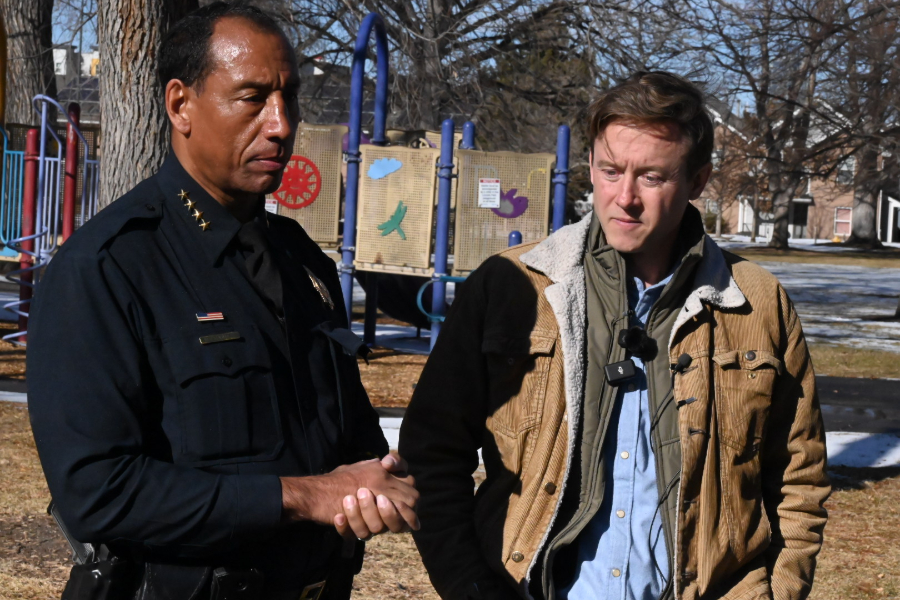
Denver Police Chief Ron Thomas recently told the Denver Gazette that his officers would step in and intervene if ICE or other federal agents were using excessive force. “If we see a federal officer who we believe is using excessive force, then I think our expectation is to intervene in that situation,” Thomas said.
“Of course, we would step in and intervene if the act is so outrageous and compelling to the conscience,” says Aurora Police Chief Todd Chamberlain in the written statement. “It is not just the law or our policy. It goes beyond tactics and what is right or wrong and comes down to morals. If our offices witness an egregious or excessive use of force, they will not only step in, but will also report that use of force to their supervisors, just like they would if it involved any other officer.
On January 30, the United States Department of Justice announced it would investigate Pretti’s death as a possible civil rights violation. So far, it hasn’t made any plans to do so in Good’s case.
Mask Bans
ICE agents are known to cover their faces. Critics argue that this allows them to skirt accountability, hides impostors and intimidates people exercising their rights.
Denver City Council started considering a mask ban on January 12, when councilmembers Shontel Lewis and Flor Alvidrez presented the idea to the Budget and Policy Committee. However, no councilmember has brought up a formal proposal since then.
Some councilmembers said they were doubtful that local police officers would be able to easily arrest or unmask federal ICE agents if a ban were passed. Councilwoman Amanda Sawyer, whose central Denver district was the site of one of the first large ICE operations in Denver, suggested that having DPD officers at a raid to arrest masked agents might create a more chaotic scene, adding that “DPD’s presence would have made things worse” at previous raids.
State lawmakers are considering introducing their own measures. At a February 2 press conference, Democratic Representative Yara Zokaie said that a mask ban would be proposed in the Colorado Legislature, alongside other bills meant to keep ICE in check.
Lawsuits Against the White House
Since Trump returned to office in January 2025, Colorado Attorney General Phil Weiser has sued his administration fifty times.
A handful of the lawsuits are in response to attempts by the Trump administration to pressure Colorado to assist with immigration enforcement. Such pressure has come in the form of withholding federal funding for transportation, disaster relief and crime-victim grants. Other Colorado lawsuits are attempting to protect immigrant medicaid data and access to safety-net programs.
Federal judges have issued preliminary injunctions to protect immigrant data and some of Colorado’s federal funding, and the Trump administration has lost lawsuits filed for crime victims and disaster funding, as well.
Congressmen Jason Crow and Joe Neguse sued the Trump administration in July after they were denied access to the Aurora ICE detention center. They won the lawsuit in December, but were again denied entry in January. On February 6, they reported showing up at the Aurora center unannounced and successfully touring the ICE facility.
The City of Denver has filed five lawsuits and joined three others against Trump; most of them involve immigration issues or federal funding withheld for refusing to cooperate with ICE. Last year, the city was able to claw back federal transportation, airport and large-scale security funds that were frozen because of Denver’s so-called sanctuary policies or the city’s laws limiting cooperation with ICE.
On January 22, the City of Denver filed a supportive brief in a lawsuit filed by the State of Minnesota two weeks earlier to stop Operation Metro Surge. On January 31, a federal judge ruled against an injunction to halt the enforcement operation.
Sanctuary Schools
Denver Public Schools, the largest school district in the state, could soon consider a policy to limit teachers from cooperating with immigration agents and restrict school security and police officers from putting students at risk of deportation.
The DPS school board hasn’t formally introduced the proposed policy, but a draft was posted online February 5. At a meeting that day, boardmembers said that they would like to give the public and themselves more time to consider the policy, some some of them hadn’t even read it.
Although ICE once had a policy that restricted agents from arresting peope at sensitive areas like churches, courts and schools, that was lifted on January 21, 2025, shortly after Trump took office. The proposed DPS policy would make Denver school campuses, transportation, bus stops and events “sensitive locations.”
DPS isn’t the only major Colorado school district to take steps to protect immigrant students. On January 16, 2025, the Adams 12 Five Star Schools adopted a resolution promising to protect immigrant students and to not ask anyone’s immigration status.
On January 22, 2025, Aurora Public Schools updated district guidelines to require ICE agents to wait outside or at a front office while their warrants are verified, and to not give agents any student’s records or other information without a subpoena or court order. According to APS policy, staff is also supposed to note an agent’s name and badge number if they come to a school, and “if the immigration officer is argumentative or disruptive, the principal may place the school on a hold,” which means clearing the hallways while classes continue.
Jefferson County Public Schools passed a resolution in February 2025 declaring that federal immigration law enforcement activities “harmfully disrupt the learning environment to which all students, regardless of immigration status, are entitled.”
Resolutions and Denunciations
On January 12, Aurora City Council passed a resolution denouncing ICE for Good’s death and the violence in Minneapolis. About fifty people spoke before the vote, urging the council to pass the resolution; other residents mailed in their support.
The resolution stated that “ICE extrajudicially killed Renee Nicole Good,” and called the ICE detention center in Aurora “a stain on our city, where 20 percent of residents are born outside the U.S.”
On February 4, state Senate and House leaders signed a joint resolution calling on the federal government to “refrain from civil immigration enforcement actions in or near courthouses, schools, health clinics, faith spaces, food distribution sites and civic gatherings.” The resolution also asks the federal government to “advocate for modernized, humane federal immigration reform,” and for Congress to “pursue reforms,” among other steps.
In January, Democratic lawmakers introduced Senate Bill 26-005, which would give Coloradans the power to sue federal agents if they’re injured during civil immigration enforcement. On February 2, the bill passed its first vote in the Senate Judiciary committee.