
Monika Swiderski for Denver Westword

Audio By Carbonatix
Keep Westword Free
We’re $1,500 away from our spring campaign goal!
We’re aiming to raise $20,000. Your support ensures Westword can continue watching out for you and our community. No paywall. Always accessible. Daily online and weekly in print.
We’ve all seen the tough expressions and folded arms of attorneys who promise to earn drivers a quick buck from a bad accident.
Personal injury lawyer names like “the Strong Arm” and “Bachus & Schanker” have been etched into the memories of Denver residents for decades. But there’s a new kid in town, and above it.
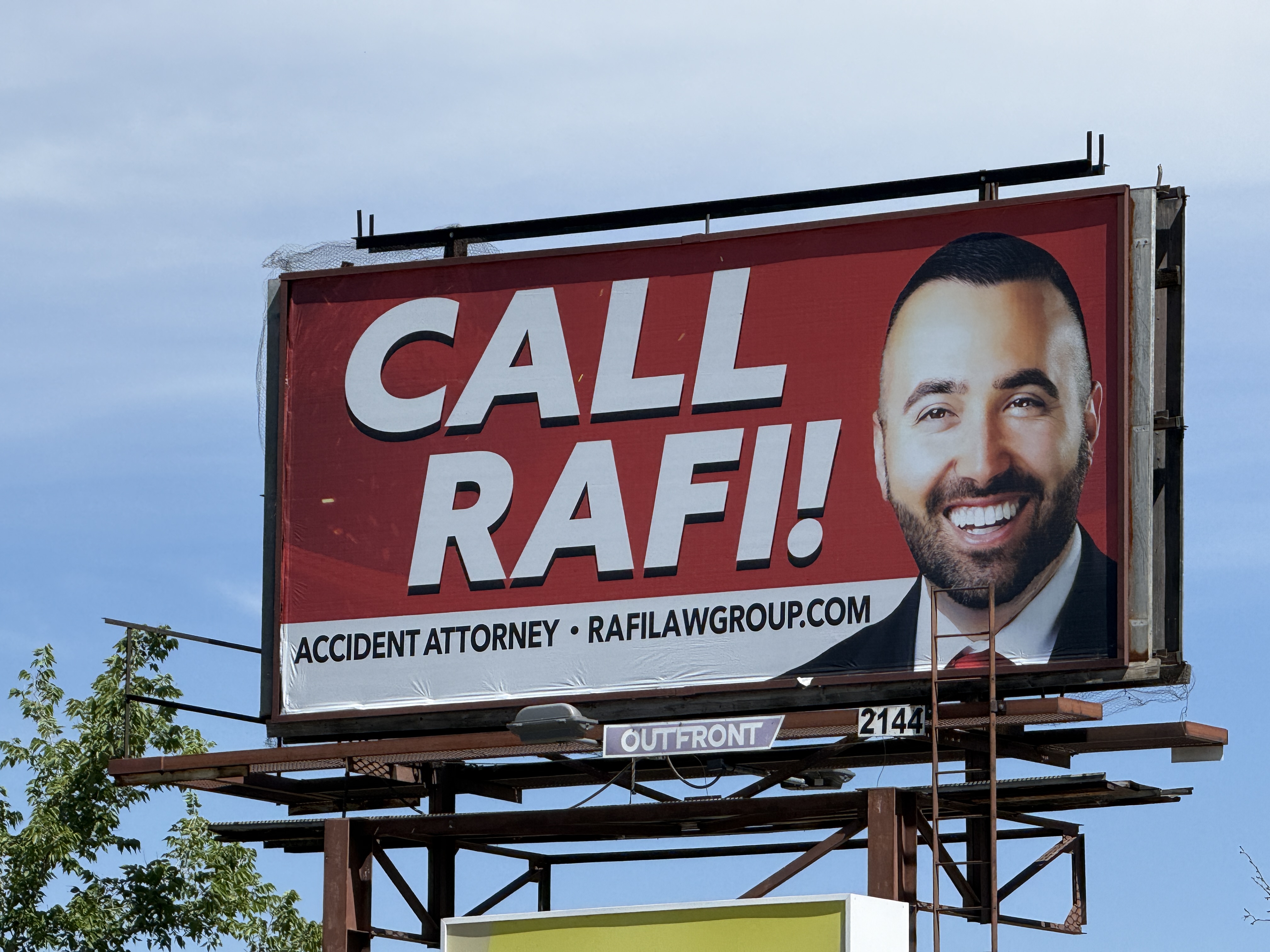
Since opening in Denver in June, Rafi Law Group has gobbled up much of the Mile High’s scarce real estate in the sky, with attorney Brandon Rafi smiling across a bright red background on billboards throughout the metro. He also has a radio jingle, t-shirts, a podcast and an entire production studio based in his home city of Phoenix as he launches a new branch in Denver.
As Rafi rapidly grows his grip on the metro’s billboard game, even his social media team has poked fun at the number of ads across Colorado.
So why, in the internet age, are lawyers still worried about billboards?
Ego is involved, of course, but there’s much more to it than a desire to line highways with headshots and catchphrases.
Catching eyes
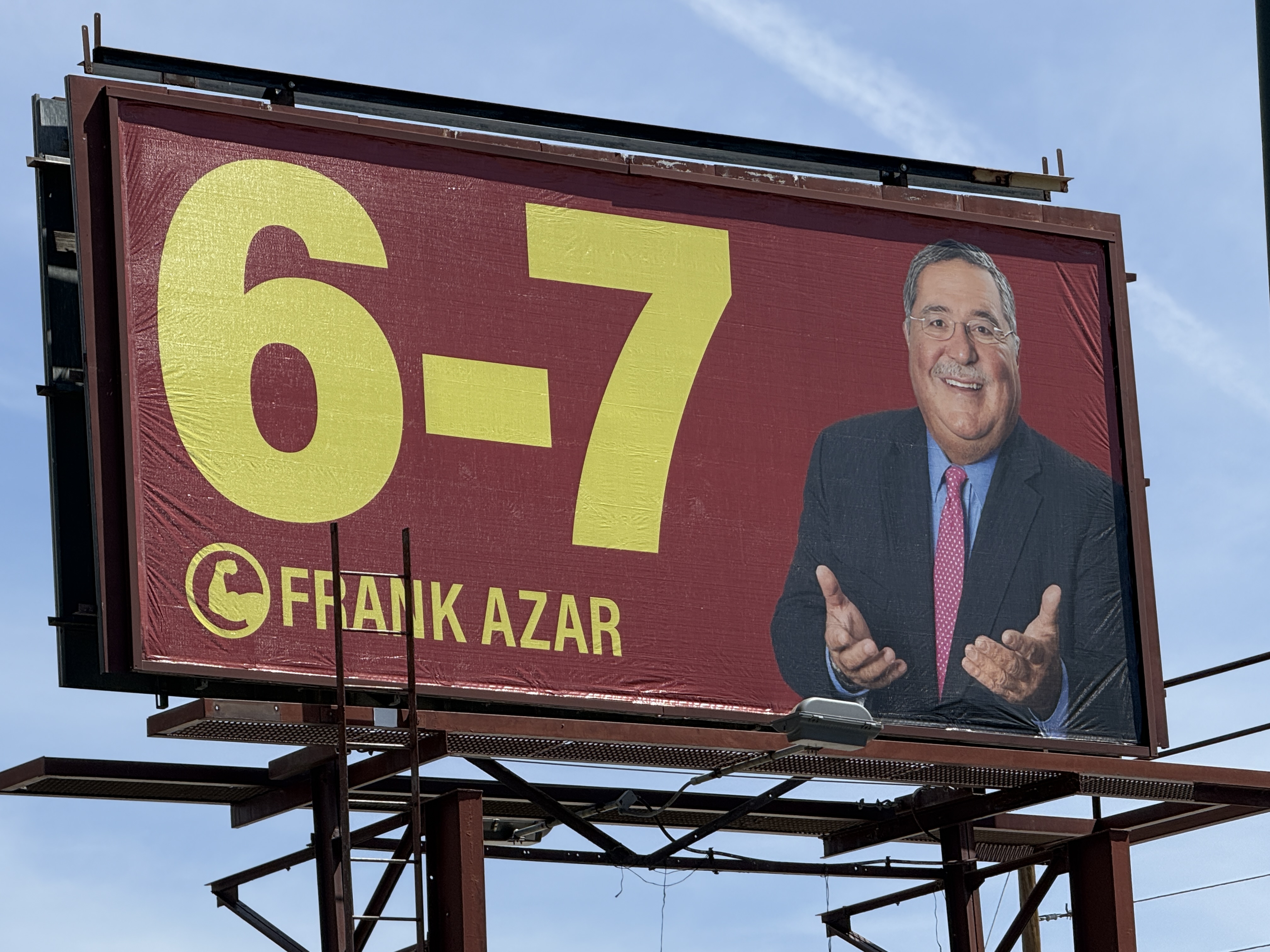
The glowing absurdity of lawyer billboards was recently showcased when longtime injury attorney Frank Azar paid for a handful of signs displaying his services along with a giant “6-7” across the metro earlier this spring, directly playing into an internet meme that adults are still trying to figure out – including someone in their 60s, like Azar.
Whether all of the signs have meaning or not, they catch eyeballs. Azar also has billboards that have been upside down for months near East 13th Avenue and Cherokee Street and near Santa Fe Drive that read, “Truck wreck?”, perhaps to speak directly to drivers who have flipped their cars.
Antony Bruno
Azar’s office didn’t respond to requests for an interview about his billboards. But Azar, who calls himself “the Strong Arm” for his ability to attain favorable results for clients, isn’t the only attorney who uses humor or billboard branding.
Bachus & Schanker like to remind people, “We win a lot.” Joseph Ramos of Ramos Law, who was a doctor before becoming a lawyer in Colorado, often prefers to appear in a white doctor’s coat.
You cannot escape them.
In a 12-mile stretch of Broadway from East Arapahoe Road to Civic Center Park, Westword observed nine lawyer billboards. Ramos Law has about 30 billboards in the Denver area alone, while Backus & Schanker have over 60 physical signs, including billboards, with their names. Fuicelli & Lee, another Denver-area firm, has four big billboards and 10 commercial wall posters.
And it’s not just billboards: Azar has radio and television ads. Bachus & Schanker appear on the sides of RTD buses. Ramos has social media ads with sports mascots.
Billboards are still king, though.
Although now commonplace in cities nationwide, lawyers weren’t originally allowed to advertise in the U.S. over worries of misleading messages. The Supreme Court eventually ended the ban in 1977, however, citing the First Amendment. Now, just like many other businesses, new law firms immediately consider advertising when launching.
Kyle Bachus, co-founder of Bachus & Schanker, says advertising for his firm dates back to its genesis in 1996; the firm was the first to get ColoradoLaw.net, he boasts.
The yearly Yellow Pages phonebook used to be a key outlet for law firms. According to Bachus, his firm spent around $600,000 annually on phonebook advertising during the publication’s peak. At the time, billboards weren’t a common tactic used by lawyers, he says.
More ad money went to television in the early 2000s, but lawyers switched to physical ads once ratings began to plummet.
“The media has fragmented,” Bachus says. “You know your local audience is out and about; you can get to them through outdoor media.”
Colorado’s roads have never seen more drivers. According to the Federal Highway Administration, there were over 4.5 million licensed drivers in Colorado in 2024, nearly 15% higher than in 2014.
“With billboards, because you’re driving down the road, everybody’s going to see it, and you might be catching people from all different markets,” Joseph Ramos, owner of Ramos Law, says.
“I had no idea I was going to have to get into advertising when I started my firm,” Ramos continues. “But you have to do what you have to do.”
Injury lawyers are often labeled ambulance chasers who churn and burn cases, and some have lived up to the stereotype. But they still have the right to advertise – and most of them agree that billboards are one of the best methods due to the volatility of the market.
Antony Bruno
“Most people who hire a personal injury lawyer have never called a personal injury lawyer in their life,” Bachus says. Other types of lawyers, like those who work in business, build longstanding career relationships at fancy dinners or on golf courses, he says. Injury lawyers usually do not have repeat clients, however.
Bachus calls the situation an “unlucky lottery,” with he and his partner, Darin Schanker, entering the game to help people on what he calls some of the worst days of people’s lives.
“Most families are a few weeks away from bankruptcy in terms of their ability, their savings,” he says. “So, all of a sudden, they’re thrust into a really bad situation, and they need help quick. We want to be top of mind.”
Rafi agrees.
“It’s not something that people go through every day,” Rafi, a practicing attorney since 2015, tells Westword. “It’s, in many cases, a once-in-a-lifetime thing, a twice-in-a-lifetime thing, and we want to be top of mind.”
What ego?
The big faces, folded arms and eye-rolling jokes are about grabbing attention — but everyone goes about it a little differently.
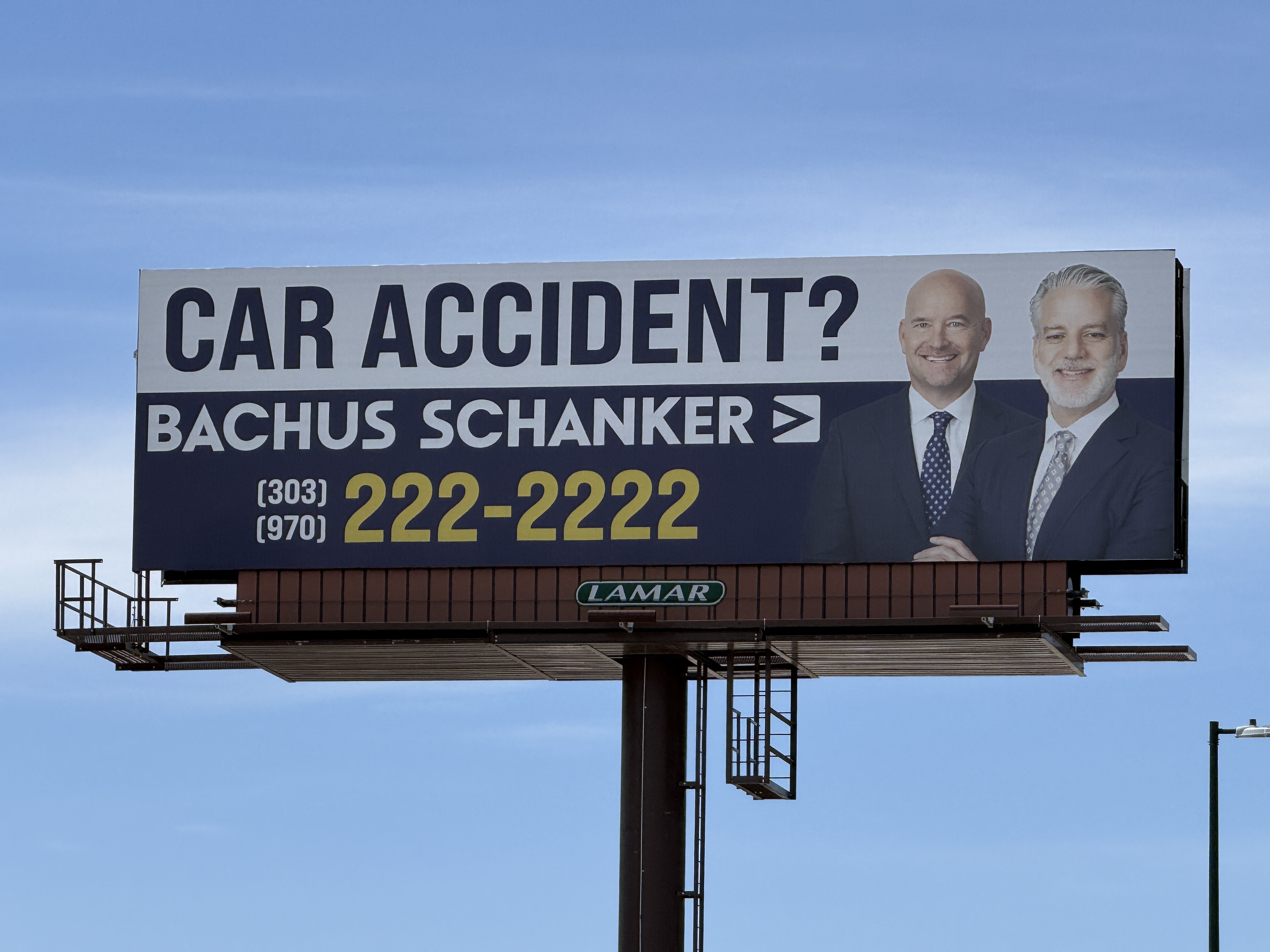
Bachus & Schanker like to appear amiable yet serious, smiling against a blue-and-white background while promoting their success rate. They don’t use jokes like the Azars of the world, but they do chase consistency.
“I don’t believe you can go without a brand,” Bachus says. “We want to be friendly and approachable. We are real lawyers who operate a real law firm for real families.”
Rafi also decided to go with a smiling face and a simple, clear message: “Call Rafi.”
“[The ads] are always about fighting … be intimidating,” Rafi says. “And so when I was first doing the creative, I was like, ‘That’s not really my personality.’ I would not be genuine by doing that.”
The 40-year-old lawyer, whose face is everywhere in Arizona and now Denver, claims he’s a bit of an introvert. He says the approach is just part of the industry’s modern landscape.
Bachus says he never wanted to put his face out there, either, but it’s part of the game.
“I’ll pull up next to a bus, and it’s got my big bald head on it,” he laughs. “I don’t like the fact that the anonymity that I had for years doesn’t so much exist here in Colorado, but it’s something I’m willing to sacrifice.”
Antony Bruno
Bachus admits there is a sense of egotism to it, but it’s from a competitive standpoint. His firm believes that “any person who’s injured in Colorado that ends up with a different law firm is losing out on an opportunity to have better representation.”
Ramos instead uses a black background with a bright splash of yellow. He likes to note that he was a medical doctor for 15 years in the metro before becoming a lawyer, entering the field to help people explain medical terms and evaluations accurately. According to Ramos, this has become his brand and what separates him from the pack.
“I never wanted my picture on any of my billboards,” he says. “I was kind of kicking and screaming, but I decided to go ahead and do it, because you’re spending so much money, you might as well get the biggest bang for your buck.”
But even Ramos says the whole billboard game is “absolutely ridiculous” at the end of the day.
Fuicelli & Lee, on the other hand, have refused to use their faces on billboards during their 18-year tenure in Denver, instead opting for animals native to Colorado. This helps them stand out while showing they are less driven by personas, and more focused on clients, they argue.
“We thought it would be cool to have the animals there to kind of draw people’s attention rather than, frankly, more white guys on a billboard,” co-founder John Lee says. “We’re different than the competition, and that’s why it’s not a matter of ego. That’s why our faces aren’t plastered on the billboards.”
New kid on the board
While the billboard race is not necessarily to pinpoint the next meme, there are still jabs across the aisle.
“There are attorneys who have found out where I live, and they’ve strategically placed billboards along my route home,” Ramos alleges with a laugh. “There’s absolutely a strategic card game that goes on with it.”
Bachus says when they entered the billboard arena, they did so with fervor: “We’ve always been go big or go home.”
Then there’s Rafi, who has hit marketing hard during his short time in Denver — and when any new competitor comes in with deep resources, the established players take another look at their own game plans.
“I’ll tip my cap to him. It’s a really competitive market,” Lee says of Rafi. “We’ve only practiced in Colorado, and we’ve both been practicing for more than 25 years. He’s from somewhere else, and so if he wants to come in here, good luck.”
Bachus calls Rafi Law Group an “out-of-state law firm coming into our state and putting up billboards and sending those calls to a call center in Arizona.”
“That sort of entry makes it all the more important for us to make sure that our message is out there,” Bachus says.
Rafi says he hires Colorado-based employees for his Denver headquarters and wants to establish himself as a real figure in the community through his nonprofit and charitable donations. The sheer amount of real estate he’s taking up could drive the market up, however, especially when it comes from a firm valued at around $450 million.
“[Rafi is] a giant in the market, and for him to come in, he takes up that real estate. What happens to the other attorneys is that they start having to pay more,” Ramos says.
Even with such a big budget behind the new competition, Lee still has faith in Denver’s current billboard king: “Let’s be honest: Who’s going to outspend Frank Azar?” he asks.
There is one thing every lawyer interviewed by Westword agrees on: The big winners here are Denver billboard companies, which are able to pit firms against each other while raising rates in a limited market.
Scarcity in the city
Billboards have always been tough to erect in Denver. The city tried to outright ban billboards in 1971, stopping all new construction and issuing an order that standing billboards be taken down. But a billboard company from Arizona sued the city, and the Colorado District Court (and later the Colorado Supreme Court) sided with the company.
The rules and restrictions are still pretty strict, though.
“There’s a lot of regulation, a lot of limitation, limited space,” Bachus says.
Billboards within Denver city limits can only be in specific zones, including areas around the National Western Center, the theater district, Peña Station and specific Billboard Use Overlay Districts, like Santa Fe Drive. These do not count areas not directly owned by the city, such as major highways overseen by the state Department of Transportation. Furthermore, signs cannot be above certain heights, illuminated late at night or animated (unless they’re on 16th Street).
These regulations were set in the city’s 2010 zoning code. According to T.C. Beohnet, a supervisor on the city’s commercial zoning team, Denver rarely sees any new billboards put up.
“What we have in place now is developed from a list of standards that we’re trying to protect,” he says. “We want to make sure that we can allow for people to do business, but fit within our regulations to make sure we’re doing what we want to do in the City and County of Denver.”
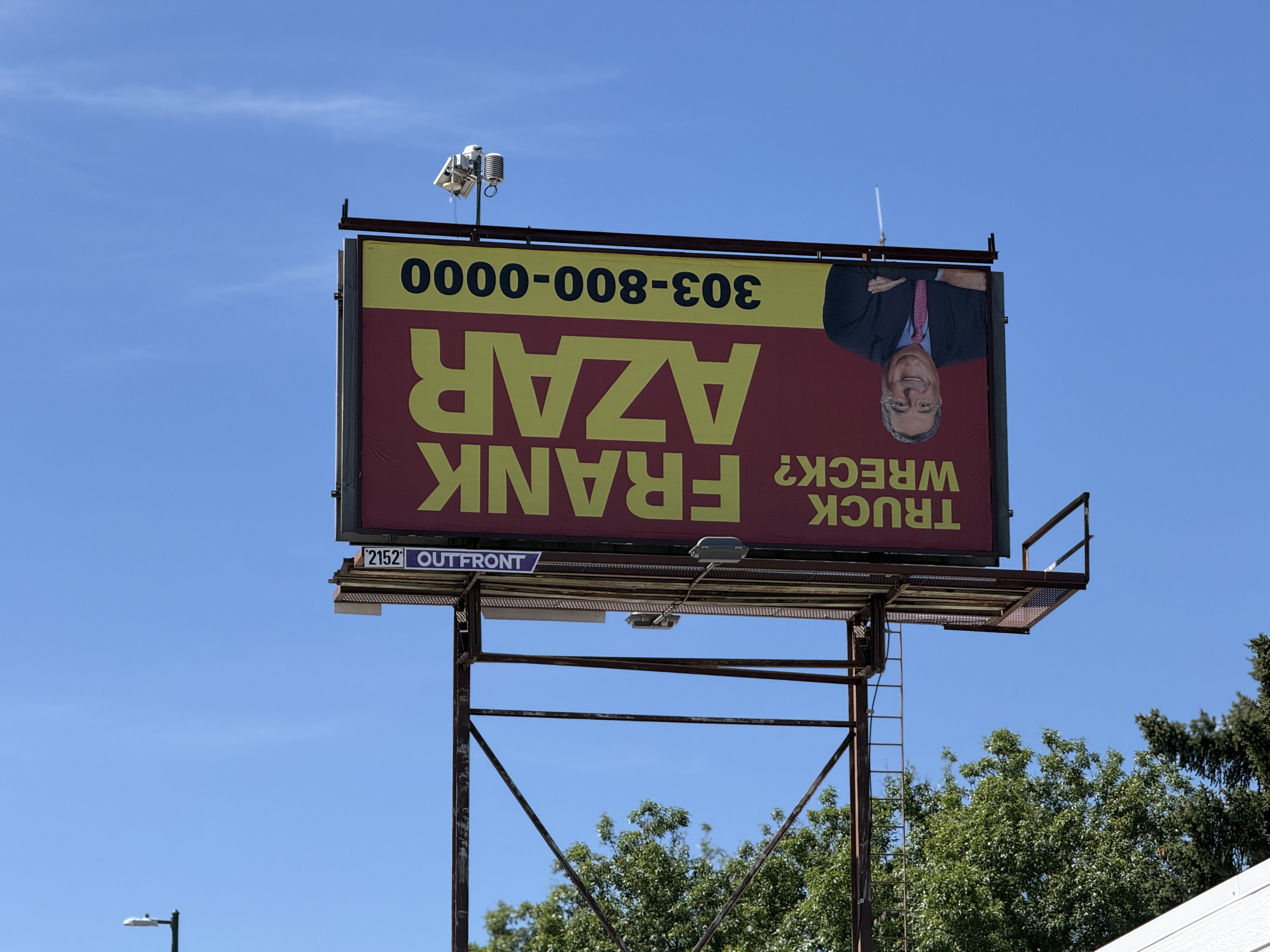
Antony Bruno
Most billboards in the Denver area are owned by companies like Outfront and Lamar Advertising, and lawyer advertisements make up a “meaningful portion,” according to Lamar Advertising communications manager Allie McAlpin.
None of the law firms interviewed would share their advertising budgets. Ramos says that, depending on size and location, billboards can cost $2,000 to $10,000 per month.
“Nowadays, if you’re going to get a billboard, you are going to be prepared to pay thousands of dollars per month,” Ramos says.
The growth in these ads is a nationwide phenomenon.
The American Tort Reform Association, a nonprofit that seeks to limit civil verdicts and reform the justice system, released a 2024 study estimating that lawyers spent around $2.5 billion on advertising on all mediums throughout the country, a 32% increase from 2020. Denver didn’t place in the top 12, with Los Angeles and New York City taking first and second, respectively. Florida cities with significantly smaller populations and land areas, such as Orlando and Fort Myers, also made the list.
“As compared to cities of the same size, Denver is currently underserved when it comes to [outdoor ads] due to zoning restrictions,” McAlpin says. “It’s unfortunate, because billboards have proven to be one of the most cost-effective advertising mediums for local businesses seeking to increase visibility and attract customers.”
Denver may have a lot of billboard lawyers, but there could be more Azars, Rafis and lawyer-inspired animals looking down upon you.
“It’s a good thing, right?” Lee says of the scarcity. “If it’s so beautiful here, why would you want to put a billboard up in front of it?”